
Every year, B2B SaaS companies spend significant portions of their marketing budget on conferences and events. And every year, when finance asks what those events actually returned, most marketing teams struggle to give a clean answer.
The problem is rarely that events didn't deliver. It's that most companies either measure the wrong things, or never set up the conditions to measure anything at all.
Key takeaways:
Event Return on Investment (ROI) and Return on Event Investment (REI) are related but different: ROI measures financial return; REI measures success across all event stakeholders
Most B2B teams track activity metrics rather than commercial outcomes
CRM attribution data is almost always inflated without pre-defined tracking rules
The inputs that matter most are pipeline sourced, cost per qualified meeting, and deal velocity
Measurement must be planned before the event
What event ROI actually measures
Let's be precise about terminology, because this is where a lot of confusion starts.
Return on Investment (ROI), in the context of a B2B event or conference, measures the financial return on what you spent. The core calculation is straightforward: pipeline value sourced or influenced by the event, divided by total event cost. A 3x to 5x pipeline multiple is a reasonable benchmark for a well-run B2B programme at a major show.
ROI is important, but it tells only part of the story. At The Hook Studio, we use a broader framework called Return on Event Investment (REI), which measures success across all the key stakeholders that make an event possible: organisers, delegates, and sponsors where applicable. An event can show a positive financial ROI for the organiser while still failing to deliver value for delegates or sponsors, which means it won't sustain itself over time. Real event success is about whether it created enough value for every key stakeholder to want to do it again.
But for the purposes of this article, we're focusing on the ROI calculation: the financial return for the organiser, and why most B2B companies get it wrong.
The inputs that actually matter
Most companies track the wrong things from an ROI perspective. Badge scans, leads captured, and booth traffic are activity metrics. They tell you what happened on the day. They don't tell you whether the event moved revenue.
The inputs that matter for a meaningful ROI calculation are:
Qualified conversations, not total leads collected
Meetings booked with ICP-fit prospects during or immediately after the event
Opportunities sourced by the event (first meaningful touchpoint) versus influenced (existing contact attended and deal progressed within the attribution window)
Cost per ICP-fit meeting, compared against your other acquisition channels
Pipeline at 90 and 180 days post-event (or however long your average deal cycle is)
That last point matters more than most teams realise. A 30-day pipeline snapshot after an enterprise event tells you almost nothing useful. Enterprise sales cycles run long, and the value of a conference conversation often shows up in pipeline weeks after the event itself.
Why the CRM data usually misleads you
Here is where most teams run into real trouble. After every event, the CRM shows a large number of “influenced” opportunities. It looks like strong performance. But that number is almost always inflated.
Standard CRM logic counts any contact associated with an open opportunity as influenced by the event, whether or not that contact had any real involvement in the deal. A contact who visited your booth but has no relationship with the buying team gets counted the same as the economic buyer who had three meaningful conversations with your sales team. Once someone starts checking the detail, the attribution picture looks very different from the headline number in your CRM marketing reports.
The fix is possible, but it takes discipline: define your attribution rules before the event. Agree on what “sourced” means versus “influenced”, and make sure those rules are built into your CRM. Every contact involved in a deal should be tagged to the opportunity, and your CRM should attribute sourced or influenced marketing touches to those contacts only. There are now event tech tools that integrate with your CRM to make this tracking more seamless, which is especially useful if your system holds years of badly tagged data. When the CFO asks which specific event influenced which specific deal, you should be able to answer from the data you already have.
The most common mistakes
Without pre-defined KPIs, there is no baseline to measure against. This is the single most common reason B2B event ROI calculations fall apart: the targets were never set before the budget was spent.
Measuring too early is the second most frequent error. Report pipeline as a leading indicator at 30 to 60 days. Report revenue ROI at 90, 180, or 365 days depending on your sales cycle length.
Tracking leads instead of pipeline is the third. The number of business cards collected is not a commercial outcome. The number of qualified opportunities that progressed is.
Finally, no clear ownership of event pipeline post-show means the tracking simply doesn't happen. If no one owns it, it won't get measured.
A practical starting point
Before your next conference, answer these three questions in writing and share them with your sales and marketing leadership:
What pipeline outcome are we expecting from this event, and by when?
Who specifically do we need to meet for this to be a commercial success?
How will we track conversations from the event into the CRM, and who owns that process?
Those three questions alone will change how your team shows up on the day and how you report back afterwards.
Calculate your event ROI
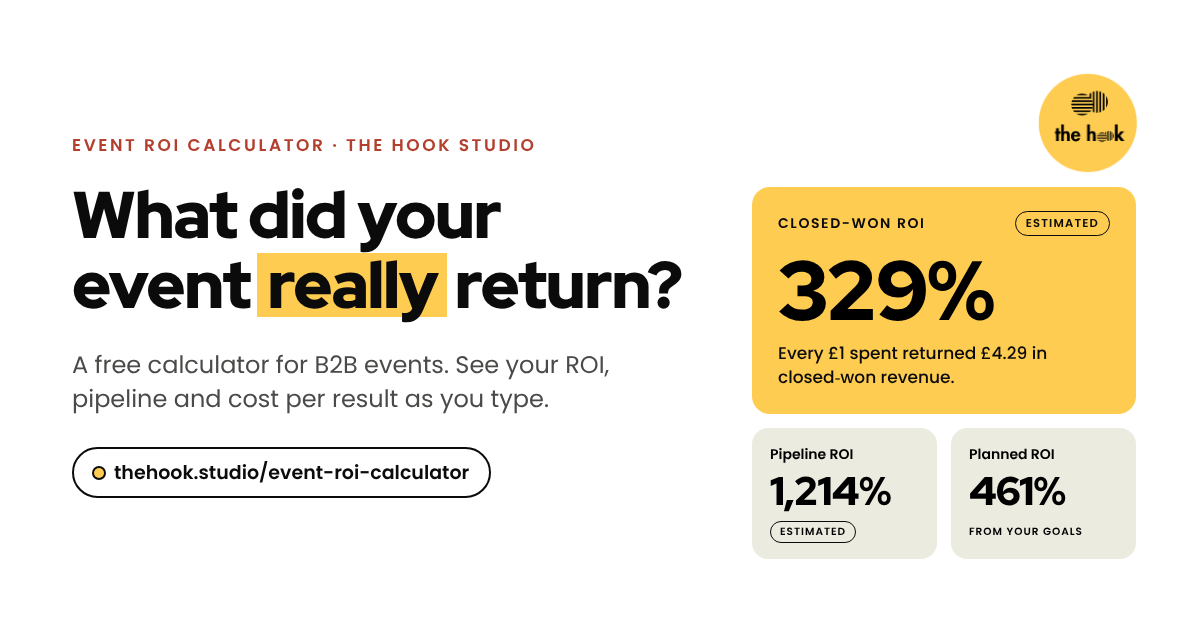
To make the ROI calculation faster and easier, the EventsROI Calculator at The Hook Studio lets you plug in your event costs, pipeline targets, and conversion assumptions and get a clear, defensible number in minutes.
Try it at thehook.studio/event-roi-calculator. It won't replace the strategic thinking, but it gives you a solid starting point before any budget conversation.
Frequently Asked Questions
What is a good Return on Investment (ROI) for a B2B conference? A healthy pipeline multiple at 180 days is 3x to 5x, meaning three to five pounds of pipeline or closed revenue for every pound spent on the event. Anything below 2x after a full sales cycle usually points to a targeting, format, or attribution problem worth investigating.
How do you measure event ROI? Start by defining your attribution rules and KPIs before the event: pipeline sourced, qualified meetings booked, cost per ICP-fit meeting, and opportunities influenced. Track those inputs in your CRM with consistent lead source tagging, and measure pipeline at 30 to 60 days and revenue at 90 to 180 days depending on your sales cycle.
What is the difference between ROI and REI for events? ROI measures the financial return on event spend for the organiser. REI, or Return on Event Investment, is a broader framework that measures success across all key stakeholders: organisers, delegates, and sponsors. An event can show a positive ROI for the organiser while still failing to deliver value for delegates or sponsors, which affects its long-term sustainability.
What inputs go into a B2B event ROI calculation? You will need to have data such as the total event cost, pipeline sourced from the event, expected win rate, and average deal value. The Hook Studio Events ROI Calculator walks you through each input step by step.
